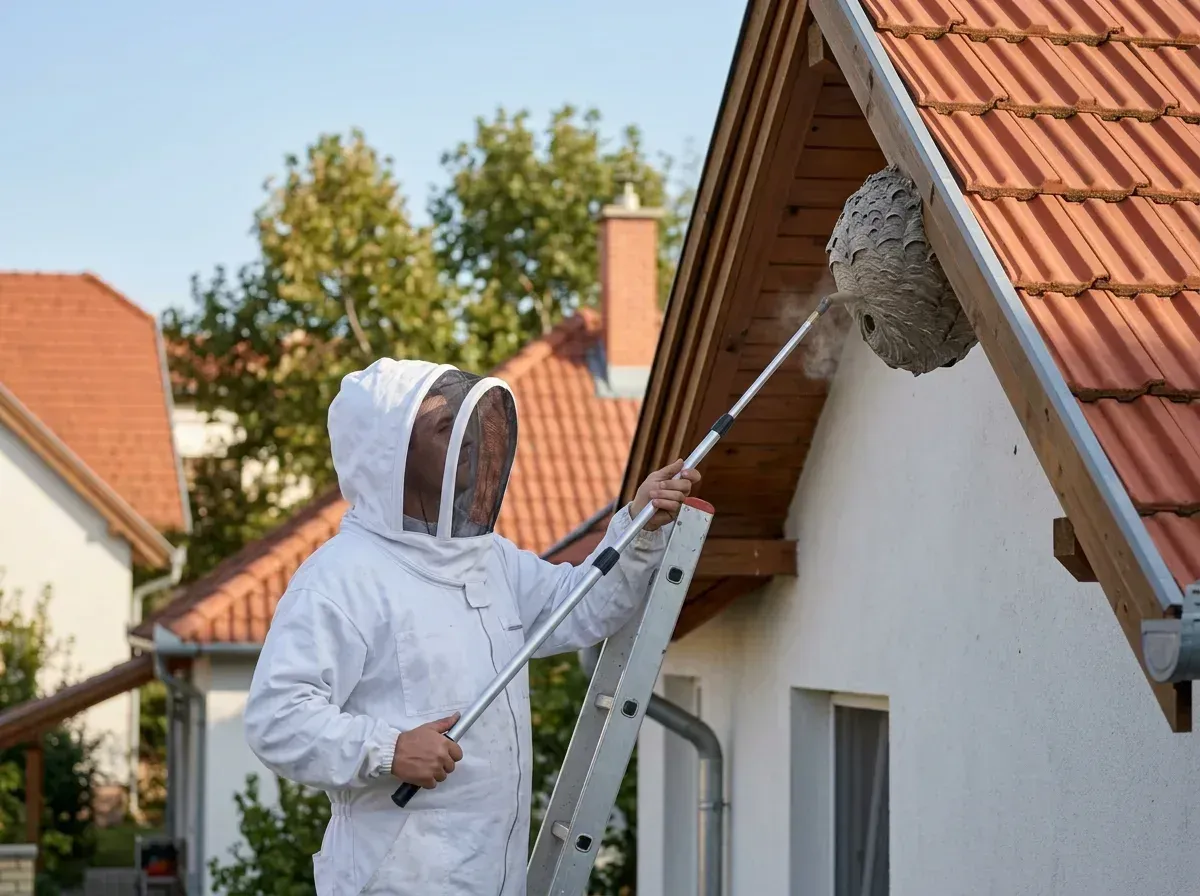
Why is it a workplace-safety matter?
A wasp nest on an industrial site is not a cosmetic problem. A sting can trigger an allergic reaction, and near a busy walkway, loading area or institutional courtyard, a defensive swarm can affect several people at once. An employer is legally required to ensure a safe working environment — and that includes removing the nest.
Hornets
The European hornet is larger, louder and more conspicuous, but no more aggressive than other species — near the nest, however, it defends decisively. Nest removal is always a professional task: the colony’s size and the nest’s location determine the method and the protective equipment required.
The appearance of the Asian hornet should be reported, as it is an invasive species.
How the treatment works
We first identify the species, then assess the nest’s location, size and how it can be accessed. Treatment is usually carried out early in the morning or late in the evening, when the whole colony is present in the nest — so a single intervention deals with the entire population. Where possible, we also physically remove the nest afterwards, because a nest left in place can attract other insects.
Prevention
The most effective way to prevent resettlement is to close off places suitable for nesting: fitting grilles over vents, sealing gaps in façades, and closing openings in roof structures. We identify the points to seal during the survey.